Resumen
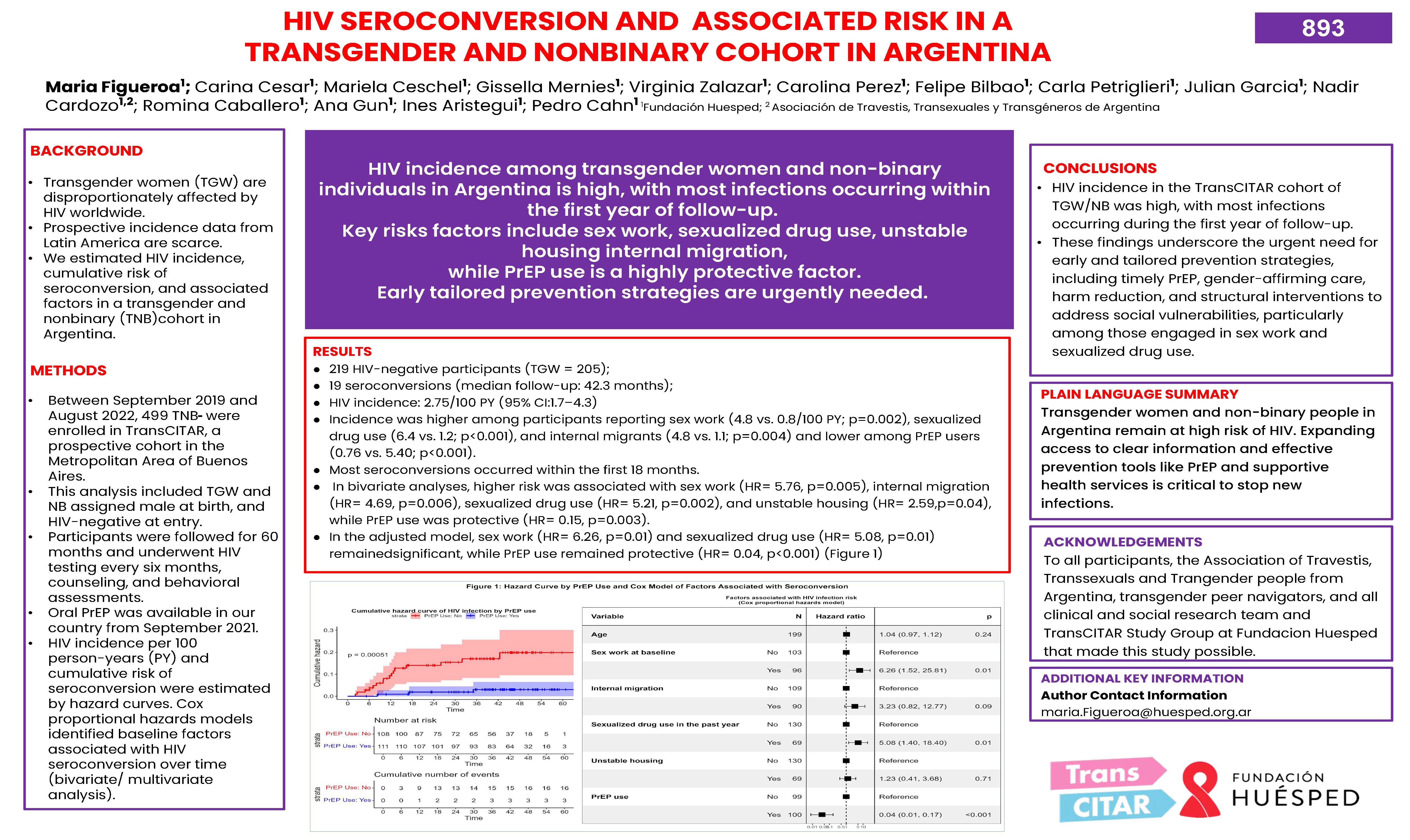
Background: Transgender women (TGW) are disproportionately affected by HIV worldwide, but prospective incidence data from Latin America are scarce. We estimated HIV incidence, cumulative risk of seroconversion, and associated factors in a TGW cohort in Argentina. Methods: Between September 2019 and August 2022, 499 transgender and non-binary individuals (TNB) were enrolled in a prospective cohort. This analysis included TGW and NB assigned male at birth, HIV-negative at entry. Participants were followed for 60 months and underwent HIV testing every six months, counseling, and behavioral assessments. Oral PrEP was available from September 2021. HIV incidence per 100 person-years (PY) and cumulative risk of seroconversion were estimated by hazard curves. Cox proportional hazards models identified factors associated with HIV seroconversion over time (bivariate/ multivariate analysis).
Results: Among 219 HIV negative participants included (205 TGW, 14 NB, median age 29 years, IQR 24-36), 19 seroconverted (median follow-up:42.3 months); HIV incidence:2.75/100 PY (95% CI:1.7–4.3). Incidence was higher among participants reporting sex work (4.8 vs. 0.8/100 PY; p=0.002), sexualized drug use (6.4 vs. 1.2; p<0.001), and internal migrants (4.8 vs. 1.1; p=0.004) and lower among PrEP users (0.76 vs. 5.40; p<0.001). Cumulative risk of seroconversion increased mostly the first 18 months: 1.4% (95% CI: 0–2.9) at 6 months; 4.7% (95% CI: 1.8–7.5) at 12 months; 7.2% (95% CI: 3.6–10.7) at 24 months; 9.0% (95% CI: 4.9–12.9) at 36 months; and 9.9% (95% CI: 5.5–14.2) at 48-60 months. Over half of seroconversions occurred in the first year. In bivariate analyses, higher risk was associated with sex work (HR= 5.76, p=0.005), internal migration (HR= 4.69, p=0.006), sexualized drug use (HR= 5.21, p=0.002), and unstable housing (HR= 2.59, p=0.04), while PrEP use was protective (HR= 0.15, p=0.003). In the adjusted model, sex work (HR= 6.26, p=0.01) and sexualized drug use (HR= 5.08, p=0.01) remained significant, while PrEP use remained protective (HR= 0.04, p<0.001) (Figure 1).
Conclusions: HIV incidence in this cohort of TGW/NB was high, with most infections occurring during the first year. These findings underscore the urgent need for early and tailored prevention strategies, including timely PrEP, harm reduction, gender-affirming care, and structural interventions to address social vulnerabilities, particularly among those engaged in sex work and sexualized drug use.
Autoría:
FIGUEROA, María Inés;
CÉSAR, Carina;
CESCHEL, Mariela;
MERNIES, Gissella;
ZALAZAR, Virginia;
PÉREZ, Carolina;
BILBAO, Felipe;
PETRIGLIERI, Carla;
GARCÍA, Julián;
CARDOZO, Nadir;
CABALLERO, Romina;
GUN, Ana;
ARISTEGUI, Inés;
CAHN, Pedro
Autoría institucional:
Fundación Huésped (Argentina)